
Indian Space Research Organisation's 101st mission from Sriharikota, an earth observation satellite onboard the agency's trusted Polar Satellite Launch Vehicle (PSLV) rocket, could not be accomplished on Sunday following a pressure issue in the third stage of the launch vehicle, the space agency said.
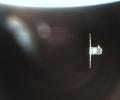
The Indian Space Research Organisation (ISRO) has successfully performed the docking of satellites as part of the Space Docking Experiment (SpaDeX). The docking was achieved after a series of maneuvers, including a trial attempt on January 12. The SpaDeX mission, launched on December 30, 2024, aims to demonstrate in-space docking technology using two small spacecraft. This technology is crucial for achieving complex mission objectives that require multiple rocket launches.

India on Friday moved a step closer to launch its maiden unmanned moon session when the lunar spacecraft Chandrayaan-I was mated with the polar rocket which is set to blast off on October 22 from the Sriharikota spaceport. Gearing up for the final countdown, Space officials said all operations for the mission are progressing satisfactorily and barring a cyclone threat the PSLV-C11 will keep the date with the country's historic mission on October 22.
The final 52-hour countdown for the October 22 launch of the country's first moon mission, Chandrayaan-I, began early on Monday morning at the Satish Dhawan Space Centre at Sriharikota in Andhra Pradesh.
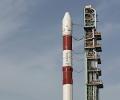
ISRO said, initially the launch was slated for 9.49 am, but now there is a 3-minute delay owing to the probability of space debris in the path of rocket.

In a textbook mission, ISRO's PSLV-C32 lifted off from Sriharikota and later injected the IRNSS-IF in sub-Geosynchronous Transfer Orbit.

In its first multi-orbital launch, India's workhorse PSLV will on Monday inject eight different satellites, including the country's weather satellite SCATSAT-1 and five from other nations, into two different orbits.

Around 23 minutes after lift-off, the primary satellite got separated and it was followed by six other co-passenger satellites, which were deployed into the intended orbits sequentially, ISRO said.

ISRO said the upper stage of the Polar Satellite Launch Vehicle - C37 (PSLV-C37) re-entered the earth's atmosphere on October 6, 2024 and the impact point was the North Atlantic Ocean.

India's launch preparations for the ambitious Rs 450 crore Mars orbiter mission achieved a major milestone with the successful thermo-vacuum test of the spacecraft with its payloads (scientific instruments).
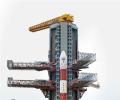
A 48-hour countdown began on Monday for the launch of record 20 satellites, including India's latest earth observation Cartosat-2 Series Satellite, onboard PSLV C-34 from Sriharikota on June 22.

The primary satellite TeLEOS-2 is a synthetic aperture radar satellite developed under partnership between Defence Science and Technology Agency (DSTA) representing the Government of Singapore and ST Engineering.

The polar satellite launch vehicle-C42 launch vehicle carrying the two satellites blasted off from the first launchpad at the Satish Dhawan Space Centre at 10.08 pm.

In terms of success rate, the PSLV rocket has an enviable record of 57 successful missions out of 58 commercial ones.

The ISRO is strengthening 'eye in the sky', which helped the Indian army carry out surgical strikes last year, with the launch.

In the first dedicated mission of its commercial arm New Space India Limited (NSIL), the Indian Space Research Organisation on Sunday successfully launched Brazil's earth observation satellite Amazonia-1 and 18 other co-passengers, including five built by students, onboard a Polar rocket from the spaceport in Sriharikota.

This is the first mission by the Indian Speace Research Organisation this year.
Greet the scientists on achieving this major milestone!

The two satellites that PSLV will release in the orbit will help the country's mapmakers and amateur radio operators.
India will join an elite group of nations with the launch of a new mission to test re-entry technology, which would be a forerunner to developing reusable vehicles like space shuttles.

The countdown began at 6.27 am for the launch on board ISRO's third generation workhorse Polar Satellite Launch Vehicle, in its 47th flight, ISRO said.

Microsat-R, an imaging satellite, is meant for military purposes, but the ISRO did not give any details about it.
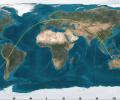
The Indian Space Research Organisation (ISRO) announced that the fourth edition of the PSLV Orbital platform Experiment Module (POEM-4), used for the space docking experiment mission, has successfully re-entered the Earth's atmosphere. The module, a repurposed spent upper stage of the Polar Satellite Launch Vehicle, impacted at 02:33 UTC (08:03 IST) on April 04, 2025, in the Indian Ocean. This successful re-entry signifies ISRO's commitment to mitigating space debris and contributing to the long-term sustainability of the outer space environment. POEM-4 had hosted 24 payloads during its mission life, yielding valuable science data. ISRO and the United States Space Command (USSPACECOM) closely monitored the module's orbit decay and predicted the re-entry date. This event showcases ISRO's proactive approach to responsible space operations.
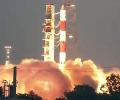
'There's too much coincidence in back-to-back failures of missions critical to national security.'

Heralding a new era, India on Friday night launched its heaviest commercial space mission ever with its polar rocket successfully putting five British satellites into the intended orbit after a flawless takeoff.

The Indian space agency has already begun work on the third generation of the earth observation satellite -- the first of which will be ready by 2018 and boost the capability to generate digital maps.
ISRO's Polar Satellite Launch Vehicle-C6, carrying India's remote sensing satellite CARTOSAT-1 and a micro satellite HAMSAT, blasted off from the Satish Dhawan Space Centre in Sriharikota on Thursday.

Other than the Cartosat-2 series satellite, the PSLV is carrying 29 nano satellites from 14 countries - Austria, Belgium, Chile, Czech Republic, Finland, France, Germany, Italy, Japan, Latvia, Lithuania, Slovakia, the United Kingdom and the United States of America besides a nano satellite from India.

India's ambitious space mission to explore planet Mars would be launched on November 5 from the spaceport of Sriharikota, ISRO announced on Tuesday.

Indian Space Research Organisation's second mission of the year to place an earth observation satellite by a GSLV rocket faced a setback as the mission could not be accomplished fully due to performance anomaly in the cryogenic stage of the rocket, the space agency said on Thursday.

The primary goal of HysIS, whose mission life is five years, is to study the earth's surface in visible near infrared and shortwave infrared regions of the electromagnetic spectrum.

The successful orbiting of the satellites by the Polar Satellite Launch Vehicle PSLV C-40 comes four months after the Indian space Research Organisation's mission to launch backup navigation spacecraft IRNSS-1H onboard PSLV-39 ended in a rare failure.
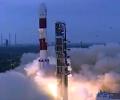
RESOURCESAT-2A, intended for resource monitoring, is a follow-on mission to RESOURCESAT-1 and RESOURCESAT-2, launched in 2003 and 2011 respectively. It is intended to continue the remote sensing data services to global users provided by RESOURCESAT-1 and 2.
The success of the PSLV-C34 mission is a result of ISRO's professionalism and the hard work put in by their scientists over the last many decades., says Ajay Lele.

ISRO launched 12 Indian, 22 foreign satellites and successfully flight-tested India's first winged-body aerospace vehicle.

The launch will be a major feat in country's space history as no exercise on this scale has been attempted before.

In a landmark late Monday night journey into a new era of space application, India successfully launched its first dedicated navigation satellite using the Polar Satellite Launch Vehicle which blasted off from the Satish Dhawan Space Centre.
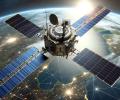
India is marching towards becoming the fourth country in the world to have space docking technology.

The Indian Space Research Organisation (ISRO) is set to welcome the new year with the launch of its first X-Ray Polarimeter Satellite that would offer insights into celestial objects like black holes, onboard a Polar Satellite Launch Vehicle rocket on Monday.
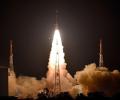
"I am really grateful to the entire ISRO family for having worked this hard and making IRNSS-1I a success," said the space centre's chief K Sivan.
 © 2026 Rediff.com - Advertise with us - Disclaimer - Privacy Policy - Sitemap - Feedback - About us - Terms of use - Grievances